
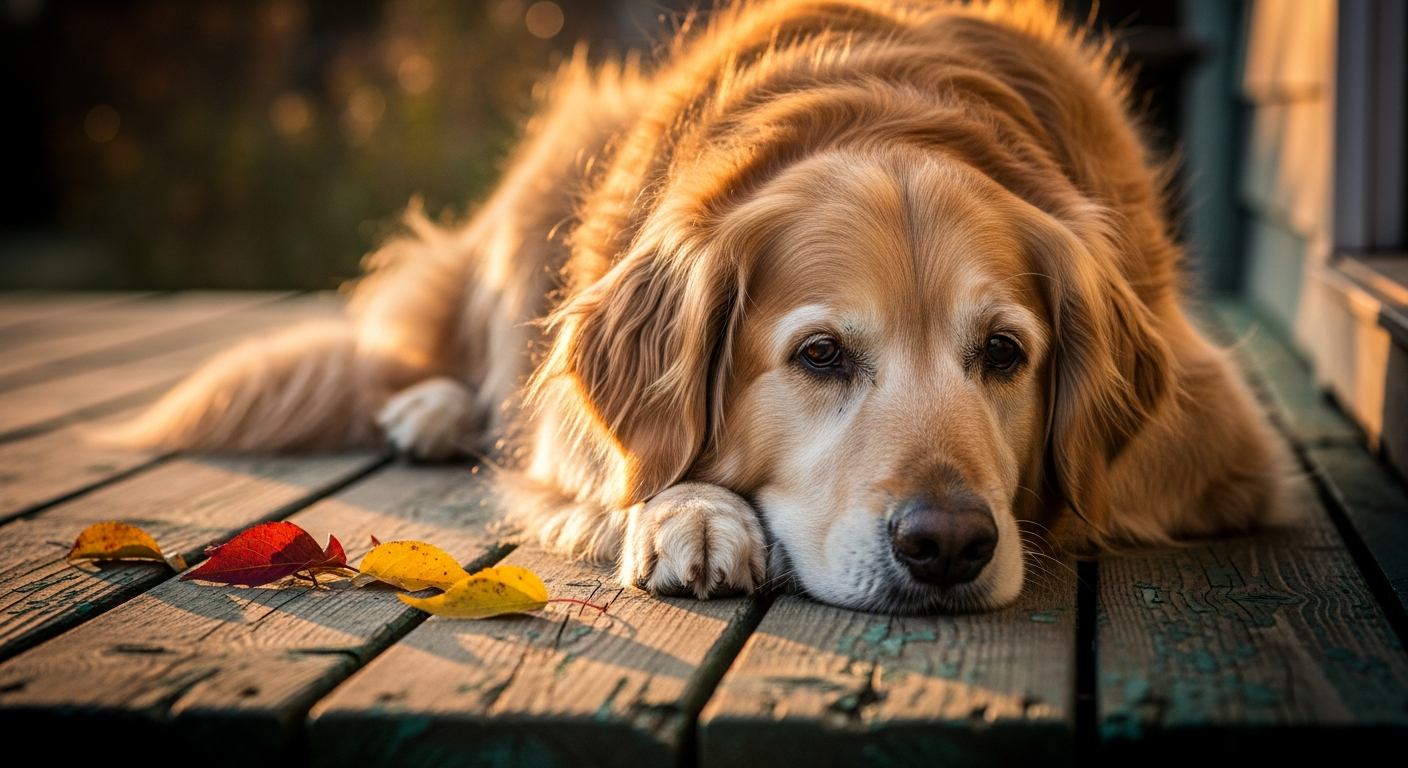
For eleven years, Willa walked three miles with me every morning. She was a light-gold Retriever with a black freckle on her nose, and she considered the morning walk the most important appointment of her week. At five AM, regardless of weather, she would stand at the door with her leash in her mouth, and if I was slow to rise she would come into the bedroom and drop the leash on my face. I can tell you, without exaggeration, that I rarely missed that walk in eleven years.
And then one morning in September of her twelfth year, she didn't get up.
I thought she was sick. I put my hand on her ribs and felt her breathing, slow and even. I checked her gums, which were pink. I called her name, and she lifted her head, met my eyes for a long moment, and laid her head back down. It was the most specific no I had ever received from her.
The Translation I Did Not Want
I did what any neurotic dog owner does. I drove her to the vet. She was loaded into the car without protest, which was the second odd sign, because Willa had always considered vet visits an outrage. The veterinarian, a woman named Dr Lin who had known Willa since she was a puppy, examined her for twenty minutes and then sat down on the bench beside me and said, gently, that there was nothing wrong with Willa.
She said: "I think she's telling you she's tired."
I sat there holding Willa's leash and I cried, the first time I had cried in my vet's office. Dr Lin did not try to stop me. She put her hand on my back and waited. When I was done, she said: "Not every decision a senior dog makes is a medical decision. Sometimes the decision is just a decision."
I took Willa home. I carried the leash back inside. Willa walked to the porch, a spot she had occasionally used in hot weather, and she laid down in the sun, and she slept.
The Porch Years
For the next fifteen months, the porch was Willa's world. I still put her leash on every morning, and she would sometimes walk to the mailbox with me. She would always walk in the yard to do her business. She would occasionally come on a short car trip to a favourite lake, where she would wade at the edge for ten minutes and then ask to go home. But the three-mile walk was over, and she was the one who had ended it.
I will confess something that still sits uncomfortably with me. In the first weeks of this new life, I tried to make her walk. I coaxed her with treats. I tried shorter distances. I used the cheerful voice that had always worked. She watched me with an expression I now recognise as patience. She was waiting for me to stop doing the thing that was no longer useful to either of us. She was, in a sense, training me.
By the time Dr Lin's advice had fully settled into me, I had started sitting on the porch with Willa. Not beside her for a minute, but with her for hours. A morning coffee. An afternoon of reading. An evening when the fireflies were coming up and the cicadas were loud. Willa would shift her position occasionally, moving to a cooler spot on the wood, and she would look at me the way she had looked at me at the end of that first porch morning. The look said: yes, this is what we are doing now.
What I Learned From the Refusal
A senior dog's ability to say no is one of the most underappreciated capacities in the canine-human relationship. Young dogs will do almost anything you ask of them. Middle-aged dogs develop opinions but mostly keep them to themselves. It is the senior dog who has earned, through a decade of partnership, the right to decline an invitation. Learning to hear that no without arguing with it is the work of the last years.
Willa was not in pain. She was not depressed. She was not sick. She had simply, after eleven years of the same walk, concluded that she was done with that particular form of exercise, and she was ready to spend the remainder of her life watching the world go by from a slower angle. This is a perfectly reasonable thing for a creature of any species to decide, and the only sensible response on my part was to adjust my expectations to meet hers.
My broader piece on adopting senior dogs argues that senior dogs give a particular gift that younger dogs cannot. The porch was the specific form the gift took in Willa's case. I would not have sat on a porch for a thousand hours in the last year of her life without her insistence. The hours were, in retrospect, some of the most content I have ever been. She gave me that by saying no to something else.
The Rhythm of the Slow Year
The year and three months that Willa spent on the porch had its own rhythm. She ate smaller meals more often. She slept about eighteen hours a day, rising for food and water and short backyard excursions. Her coat thinned in some places and went whiter in others. She developed a new habit of lifting her head when the mail truck came, tracking it along the street until it passed our house, and then laying her head back down as if she had performed an important duty. I never figured out why the mail truck mattered to her. It was her own small job on the porch, and she did it every day.
I also learned which comforts matter in the last year. A waterproof dog bed on the porch for drizzly mornings. An elevated bowl because she had arthritis in her neck. A ramp into the house so she did not have to negotiate the two steps up from the porch. A rug in the living room so she had traction when the wood floor was too slippery for her hind legs. These small accommodations are the infrastructure of a good senior life, and our comfort care guide catalogues them more completely.
Pain management was part of the conversation, and we kept Willa on a low dose of carprofen that Dr Lin adjusted as needed. The dog who will not take medication willingly is a myth that applies mostly to otherwise healthy animals; a senior dog with a small daily pill wrapped in cheese is usually a cooperative patient, because she understands that the pill is one of the bargains she is keeping with you.
The Last Porch Morning
Willa died on a porch morning in late December. The ground was frosted and the sunlight was coming in low and gold. She had been slower for about a week. She had stopped tracking the mail truck. She had eaten less. She had slept more. On the morning she left, I was making coffee in the kitchen, and I heard her shift on the porch in a way I knew was different. I went outside and sat down beside her. She put her head on my leg, which was something she had always done and was now doing for the last time. I stayed there for a long time after her breathing stopped. The sun came fully up. I was cold by the end. I did not move until I was ready.
Dr Lin came that afternoon and helped me arrange things. I buried Willa under the dogwood in the back yard, at her request, because we had sat there together on many summer afternoons. The dogwood is in its third spring now since Willa went beneath it. The flowers open in April. I sit out there sometimes with the new dog, a rescue I brought home last summer after a long wait, and I tell her about Willa, and about the porch, and about the year that a dog taught me to sit still.
What I Want You to Know
If your senior dog has stopped wanting something she used to love, please do not assume that she is broken. She may be telling you that her priorities have changed, and that the last phase of her life requires different arrangements than the phases that came before. Our article on the gift of slow days explores this in more detail. The refusal is not a failure. It is a communication, and the job of the caring owner is to listen.
The porch was Willa's final chapter. It was slower than any chapter I would have written for her. It was also, in the strange mathematics of love, the chapter I most needed. If you are in such a chapter with your own dog, I wish you the patience to let the days be what they are, the wisdom to adapt your routines to meet your dog where she is, and the grace to recognise that the slowness is a gift.
I hope your porch is warm, and that the mail truck comes regularly enough to matter.